Showing posts with label MIT. Show all posts

Saturday, February 1, 2014

Happy 50th Birthday to the IBM Cambridge Scientific Center, Kendall Square Pioneer


The IBM Cambridge Scientific Center, CSC, once famous for its pioneering work in virtual machines and internetworking technology, was founded by Norm Rasmussen on Feb. 1, 1964. Less well remembered is the role the CSC played in the development of today’s Kendall Square as an innovation hub.

From The Reinvention of Kendall Square By Jim Miara: "In the early 1960s, Kendall Square in Cambridge, Massachusetts, looked much like the many old industrial cities across the country of the present that are drawing the curtain on the evocative past and wondering what the next act holds. The 43-acre (17.4-ha) district, once dense with factories that churned out soap, vulcanized rubber, and dozens of other products, had become a collection of forlorn, rickety structures that blighted the landscape.

“Kendall Square was a moribund 19th-century district,” said Robert Simha, director of planning emeritus at the Massachusetts Institute of Technology (MIT), which abuts the area. Simha represented MIT’s interests in Kendall Square during planning discussions from the 1960s to the 1990s. 'Companies were sliding away. People were losing jobs. The city was losing income. The few plants that remained, like the vulcanized rubber plant, were smelly and polluted the air.'”

The pioneering modern development was “Technology Square.” On Feb. 1, 1964, when the CSC was founded, the building shown below was known as 545 Technology Square. At the time, Tech Square consisted of three buildings facing a courtyard.  Since then, others have been added.  The building is practically surrounded by a substantial addition, the courtyard has been replaced by the driveway in the foreground, the building has redesigned windows, and its address appears to be  200 Technology Sq.

The building was home to the MIT AI Lab, MULTICS, Project MAC, and the MIT Laboratory for Computer Science.  


Addendum: Today’s Boston Sunday Globe  (2/2/2014) includes a number of items on Kendall Square, including “A Kendall Square Timeline” (here for subscribers), inspiring us to send the following letter to the Editor.


Your article “A Kendall Square Timeline” fails to mention the seminal event leading to the area's current prominence as a research hub.

Technology Square, on Main St.,  was announced in 1963 as a joint development owned by MIT and Cabot, Cabot, and Forbes. “Now, through this unique collaboration we will be able to provide modern facilities directly adjacent to the laboratories, libraries, and other resources of MIT.  Up until now it has been necessary for companies desiring this association to locate as far as eighteen miles away,” said CC&F President George W Blakeley, Jr., at the announcement.

The first building to open was then called 545 Technology Square (since renamed).  Initial tenants (1964) included MIT’s Project MAC and the IBM Cambridge Scientific Center.  It later became the initial home for the MIT Laboratory for Computer Science and the MIT Artificial Intelligence Lab. Many of the pioneering efforts leading to the internet were performed here.

Technology Square grew to four buildings.  The previous occupant of the location was an odorous rendering plant owned by Lever Brothers.
 

545 Technology Square is Now 200
Subscribe to the Angel Investing News


Monday, November 4, 2013

Maine Angels Encourage "Boomerang Entrepreneurs"


A “boomerang” entrepreneur is one  who grew up in Maine, went to work elsewhere, and then brought his business ideas back to where he wanted to live,  according  to a recent feature in Maine magazine.

An example is Ben Polito, CEO of Pika Energy, a company funded by the Maine Angels, the eCoast Angels of NH, and the Maine Small Enterprise Growth Fund (SEGF). Polito grew up at the remote end of Georgetown Island, beyond the reach of Central Maine Power’s utility poles for the first seven years of his life. After earning a mechanical engineering degree from MIT, where he developed 3D printers, built autonomous submarines, and worked on Eink, the display technology of the Amazon Kindle, he returned to Maine where he co-founded Pika.

Encouraging Polito and others is Don Gooding, vice chair of Maine Angels and executive director of the Maine Center for Entrepreneurial Development.

“Sorry, not a boomeranger,” says Gooding.  “I grew up in Mass., married someone who was a third generation summer person, but that's not the same. But I'm a "boomeranger catcher." In addition to Ben Polito, I've worked with Shannon Kinney of Dream Local, Stephen Andrews of Abogen, and Kristen Gwinn-Becker of HistoryIT, all of whom are high potential boomerangers.”

Dream Local has received funding from three individual Maine Angels and the Maine Venture Fund; Abogen is negotiating with the Maine Angels and presented recently at the New England Angel Capital Association syndication summit in Boston.

“Watching Gooding connect people and ideas is like watching a bee pollinate an orchard—so many flowers, so much fruit to grow!” says Maine.

Phillip Conkling reports in Maine on recent visits to the Maine Angels and to Pika Energy. “When it comes time to report on current members’ investments, Paul Farrow holds up Pika Energy’s first wind turbine blade, a sleek biomorphic form made from a new injection molding process. For homeowners, a turbine blade is the key to energy production. Blades typically cost several hundred to a thousand dollars apiece. But Pika’s new process has reduced the cost to $30 per blade, which is a key part of their strategy to reduce the costs of the machines by half of the going price. Another key to their technology is  a patent-pending microgrid that allows customers the option of plugging in solar panels and tracking system performance.

“I had visited Pika’s new facilities at a Westbrook industrial park several weeks earlier and met its president, Ben Polito, and his partner, Joshua Kaufman, director of research. The pair met while they were students at Massachusetts Institute of Technology. The six employees at Pika were still unpacking after moving out of Polito’s and Kaufman’s basement, where they have been working for the past three years. Kaufman, who greeted me while intently fiddling with a little box filled with microcircuitry, said that because 96 percent of wind customers want the ability to add solar, Pika’s sophisticated electronic micro-grid technology is at the heart of their marketing strategy. 

“Polito tells me that they have recently closed their latest round of angel financing, which allowed them to invest in manufacturing tools and to double their workforce, including hiring an experienced plant manager, formerly of Tom’s of Maine. But this is also a personal quest for Polito, who grew up at the remote end of Georgetown Island, beyond the reach of Central Maine Power’s utility poles for the first seven years of his life. He remembers “electricity was this cool thing that I saw in kindergarten and the neighbors had,” and he got interested in how electricity makes things work. At Morse High School in Bath, Polito built small turbines for science projects.  He says, ‘You don’t really know how to design stuff until you know how to build stuff.’

“Polito, who has benefited from MCED’s  Top Gun’ program, is a big believer in locating business in Maine, where everything is much more affordable and there is an ample supply of talent due to the quality of life. ‘Maine was a backwater when my parents came here,’ recalls Polito, ‘but the Internet has democratized where you can do innovation.’

Up in Aroostook County, North of the Haynesville Woods (“A Tombstone Every Mile”) close by Frenchville and the Republic of Madewaska, they say that Maine’s biggest exports are pine, pulp, potatoes, and people, eh!   Maybe someday a few more entrepreneurs will boomerang back.

Don Gooding at Work

République du Madawaska


Subscribe to the Angel Investing News


Tuesday, December 4, 2012

Are Moron Angel Investors Causing a Series A Crunch?


“Let's All Shed Tears For The Crappy Startups That Can’t Raise Any More Money,” says Dan Lyons . “And raise a glass to the moron angel investors who created this mess.”
   
So who is Dan Lyons and is he really toasting us?  Are French words best for describing both entrepreneurs and agent provocateurs?  And is there really a Series A Crunch?  In his excellent commentary today, the ever-insightful Dan Primack replies:

“Lots of tech startups that raised seed funding can't get follow-on investments from venture capitalists, thus causing the companies to disappear. It's being called the "Series A crunch" (®Sarah Lacy), and has sparked the type of schadenfreude usually reserved for a Kardashian divorce.

Be seeded, be resented.

“To be clear, I'm a firm believer in the idea of entrepreneurial meritocracy. The best companies should continue to get funded, and the lousy ones should fold so their employees can move on to more worthwhile pursuits.

“What I don't quite get, however, is why so many people believe venture capitalists are infallible arbiters of what rocks and what sucks. These are many of the same venture capitalists who helped inflate the dotcom bubble before it burst -- getting its recessionary goo all over America. And the same ones who slowed down their investing pace in the middle aughts, when companies like Facebook were just getting started. And who gave absurd late-stage valuations to companies like Zynga. And who let Andrew Mason cash out all of that Groupon stock pre-IPO. And who do you think first put money into Solyndra?

“My point isn't that venture capitalists are dummies. It's that they can make mistakes. Just take a look at the companies that Bessemer Venture Partners admits to having passed on. Every firm has regrets, and it's not unreasonable to think that certain quality startups fall through the cracks. Or that some undeserving companies get to move forward. In fact, the "Series A crunch" likely means that more errors are being made, rather than fewer (since VCs are sorting through an increased number of seed-funded deals, without getting more hours in the day).

“One more thing: Before insulting all those "dopey angel investors," it might be worth understanding why they backed so many companies in the first place. Research has shown that angels have the best chance of producing positive returns by investing in more, not fewer, startups. And I don't mean five rather than two. I mean 50 rather than 10.

“But don't let me ruin the fun of feeling superior to all those folks in Silicon Valley who foolishly chased their dreams (or who helped others to do so). I'm sure that venture capitalists will make everything work out okay..”


A Moron’s Diary

Living once again in the Northeast, I don’t believe I have heard anyone use the term “moron” since I left Texas.  In Houston, it was pronounced “moe….raawn”, accents on both syllables, and was frequently and loudly  applied to motorists of whose driving habits the speaker disapproved.  Conflict often ensued.

To apply the term moron to persons who give generously of their time, energy, experience, and savings to help give the other guy a chance to start a business and be successful, to advance technology, and to contribute to the regional economy seems a bit mean spirited. Perhaps, in these difficult times, the world would benefit from a few more good morons.

From my perch, the Series A crunch is far from proven.   Right now, seed valuations are rising, more VCs are entering the angel investing space, and our regional angel groups have joined forces to have greater control over their own destiny.

So who are we quoting today? 

Dan Lyons is Editor-in-Chief of ReadWrite. Previously, Dan was Technology Editor at Newsweek. Before that he spent a decade at Forbes, covering technology. Dan was the creator of "The Secret Diary of Steve Jobs," a satirical blog written in the persona of Fake Steve Jobs. Want another sound bite from him:

“ For the past few years we’ve had people calling themselves “investors,” who have no experience investing, swanning around the Valley, slinging money at people calling themselves “entrepreneurs” who have never held an actual job, let alone run a company. How could this have ended in anything but a train wreck?”

Dan Primack, Senior Editor, Fortune, writes a daily newsletter, TermSheet, covering the latest news on private equity, M&A, deals and movements — from Wall Street to Silicon Valley. Previously, Dan was an editor-at-large with Thomson Reuters, where he launched both peHUB.com and the peHUB Wire email service. In a past journalistic life, Dan ran a community paper in Roxbury, Massachusetts. He currently lives just outside of Boston.

Exceeding thanks go to Dan Primack for allowing us to quote extensively from today’s issue of Term Sheet. We’ll reserve our thanks to Dan Lyons until he tells us who is paying for his toast. Like the toasts at many of our youthful marriages, this one may end up costing us a great deal in the long run.
  
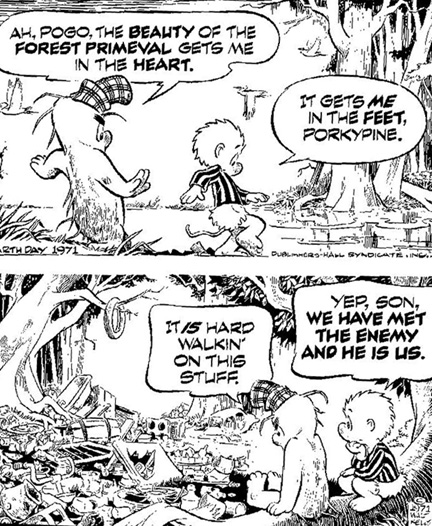
In times lang syne, Pogo cartoons proclaiming “We have met the enemy, and he is us!” once lined the Infinite Corridor at MIT.  My friend GK suggests we nominate Lyons for an Anti-Pogo Award: “We have met the enemy, and he is anyone but me!”


The illustration above is reproduced only in low resolution and is used to support our argument. We believe this qualifies as fair use under copyright law.
_________________________________________________

 Receive this blog and related angel information as an App on your smart phone or tablet. 
Instructions here: http://tinyurl.com/c6xcqar


Monday, November 26, 2012

Launchpad, Retaining Momentum, Announces Two Successful Exits


Angels at rest tend to stay at rest, while angels in motion tend to stay in motion, at least that’s my application of Isaac Newton’s laws to start-up investing. Launchpad Venture Group certainly has great momentum this year, being recognized among the largest and most active angel groups in 2011 and for the first half of 2012.

Since the emergence of accelerators and AngelList make it easier than ever to find new investments, it is a good time to recall that the angel business model does not depend on making lots of investments, it depends on successfully exiting them.

Managing Director Christopher Mirabile tells us that Launchpad has two exits so far this year.

Copiun was acquired by Good Technologies.  Launchpad sourced them, seeded them, and then invested in three additional rounds between 2009-12.  “Each round had a slightly different return, but overall we put in about $800K and got back about $3.4M for a 4.3X return.” (This could be greater depending on the success of the acquirer).

Vela Systems was acquired by Autodesk.  Launchpad did three rounds between 2006-8.  “Again, each round had a slightly different return, but overall we put in $390K and got back $1.7M for a 4.4X return.”

“In addition we have several others that are pretty close and might pop this year.  All in all, a great year for Launchpad!” says Mirabile.

Sources of these investments.


With so many new groups formed to assist us in endangering our money, we have started to ask our angels where their best deals originated.

“The founder of Copiun, Puneesh Chaudhry, approached me after I spoke
at a panel for Babson College, says Managing Director Hambleton Lord. “We discussed his idea for a company and I put him in touch with a couple of Launchpad members who had experience in his market segment.

“In the case of Vela, I believe we were introduced by James Geshwiler (of the Common Angels).  James asked me if we had any expertise in the construction /
commercial real estate market.   At the time, I was on the board of a
company that sold software into commercial real estate owners and
property managers.   In addition, we had a member, Tim Curran, with
enterprise software experience. Tim became the Launchpad  board
representative on Vela's board and then later on became the CEO of the
company.”

We congratulate Launchpad for their latest successes, with very great thanks to Christopher and Ham for sharing their experiences with all of us.

An Angel’s Diary.

At MIT fifty years ago, Professor Alan Lazarus taught every student about motion and vectors using a demonstration, running double sessions in lecture hall 26-100. He rigged up a model train with a spring loaded cannon on a flatcar pointing straight up. While the train was stationary, he fired a ping pong ball from the cannon; the ball went straight up, and then fell straight down, right back into the cannon. He repeated the experiment, with the train moving forward very slowly. Lazarus kept increasing the speed of the train, and each time he fired the cannon the ball maintained its forward momentum as it was fired, returning each time into the cannon. A very effective demonstration clearly remembered today.